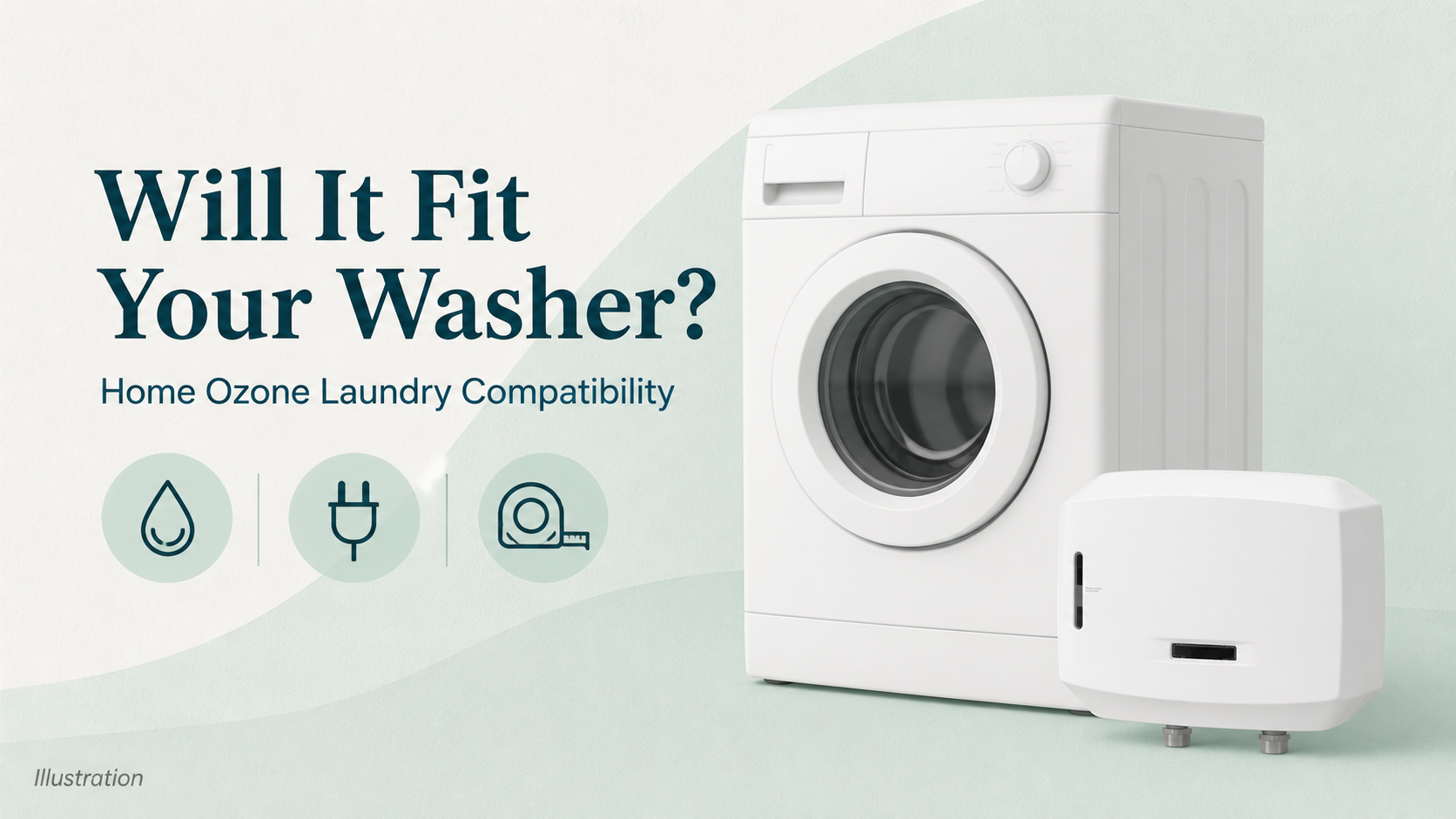
Before buying a home ozone laundry system, start with a practical question: will it work with the washing machine and connections you already have?
The O3 Eco Laundry home system is designed for residential use and connects to a household washing machine’s cold-water supply line. It is an add-on to your laundry setup, not a replacement washing machine or a commercial-laundry system.
Start with your washer model, then check the cold-water connection, power supply, and installation space. Matching a brand name or finding a hose that fits is not enough to confirm the complete setup.
Here are six checks to make before you order, plus a short checklist you can send with your inquiry.
Is your washer front-loading, top-loading, or a washer-dryer combination? Does it have a high-efficiency (HE) label? Include those details, but do not use them as a substitute for the exact model number.
Find the model number on your machine’s label or in its owner’s manual. You do not need to share its serial number for an initial inquiry. Also note whether it is a standalone washer, a stacked installation, a washer-dryer combination, or a portable machine.
If the washer manufacturer provides guidance on external water-treatment equipment, include that information too. The goal is to check your actual machine and installation rather than assume that all appliances from the same brand behave identically.
The current instruction material describes separate flow-rate settings for front-loading or high-efficiency washers and standard top-loading washers. This makes the washer type an operating detail, not just a description for the quotation. The unit should be set for the actual washer before use, following the supplied instructions.
The intended water route is from the household cold-water supply, through the O3 Eco Laundry unit, and then to the washer’s cold-water inlet. The website’s installation guide illustrates this arrangement.
Before purchasing, confirm the requirements for the unit being supplied:
If you use well water or already have a filter or softener, mention it in your inquiry. If you do not know your water pressure or connection type, say so; ask a qualified installer to identify them rather than guessing.
Water quality can affect performance. The current instruction material recommends additional attention where water has high iron content and suggests considering appropriate filtration or softening for hard water. This is not a reason to prescribe a filter without first understanding the local water supply.
The intended connection into the ozone unit is cold water only. Keep the washer’s hot-water hose installed where the washer requires it, even if the hot supply is turned off. Some high-efficiency washers may draw from both inlet connections during a cold cycle, so do not rearrange or combine the washer inlets based on a general blog article. Follow the instructions for the supplied unit and your washing machine, and obtain qualified help if a different hose arrangement is needed.
Include your country or region in the inquiry, and confirm which power adapter and plug will be supplied.
An adapter’s household electrical input and its output to the appliance are different specifications. Check both against the supplied equipment. Do not assume that a plug fitting the socket establishes electrical compatibility, or use an adapter intended for another device.
The instructions supplied with the actual unit should guide installation. If your outlet or electrical arrangement needs changing, have a qualified professional assess it before proceeding.
When water begins to flow, the unit is designed to start automatically. The current instructions describe a blue front-window light during normal operation and a flashing red light as a service warning. They also state that the unit switches off shortly after water flow stops. These indicators should be checked after installation rather than assuming that water flow alone confirms correct operation.
The O3 Eco Laundry system uses a wall-mounted arrangement. Request the current unit’s dimensions and required clearances before choosing a location.
A useful space check includes room for:
The model currently supplied by O3 Eco Laundry does not include a remote control or an automatic dehumidification function. Keep this in mind when planning an installation behind stacked appliances or inside a cabinet: do not rely on remote access or assume that moisture-management maintenance takes care of itself.
A stacked washer or an appliance inside a cabinet deserves particular attention during this check. If the area is difficult to describe, take photographs of the proposed mounting space and water connections. Mention that the photos are available when you contact the supplier.
Compatibility is also a question of intended use. Tell the supplier whether you mainly wash everyday clothing, towels, bedding, workwear, or heavily soiled items, and which cycles you normally select.
Ask for guidance on detergent use, stain pretreatment, and fabric restrictions. Do not assume that adding an ozone laundry unit means every load should be washed without detergent or that garment-care instructions no longer apply.
The current instructions still recommend pretreating tough stains. They also advise keeping a white item beneath the initial pour stream in a top-loading washer rather than placing dark or strongly colored fabric directly in that stream. Treat this as a product-specific operating precaution, not proof that every dye or fabric will react in the same way.
If you have a specific stain, fabric, or cleaning requirement, describe it when you contact us. Practical advice for your normal loads is more useful than a blanket promise covering every garment and washing condition.
The O3 Eco Laundry maintenance guide describes checking the desiccant. The current instruction material says that the visible beads change from blue to pink as they absorb moisture and that the cartridge should be replaced once the beads have turned pink. Replacement frequency varies with use and humidity. Because the current model does not have automatic dehumidification, do not treat this check as an automatic process or the appliance as entirely maintenance-free.
For an extended period without use, the current instructions say to shut off the water supply and disconnect power to both the washer and the ozone unit. The exact procedure should follow the manuals supplied with both appliances.
A useful quotation should also clarify:
Keep product warranty information separate from the washing machine manufacturer’s own terms. Ask the washer manufacturer directly if you need confirmation about using an external device with your machine. Do not assume that an accessory supplier can speak for the appliance manufacturer.
You can copy the following into your message:
Leave anything you do not know as “not sure.” The aim is to identify what needs checking before you buy, not to ask you to diagnose the installation yourself.
An exact model number and a few installation details make a compatibility inquiry much more useful than asking whether a unit “works with all washing machines.”
Request pricing and a compatibility review from O3 Eco Laundry. Tell us about your washer and location so we can discuss the requirements for your setup before you decide.
This article is a pre-purchase checklist, not an installation manual. Follow the current instructions for both products and use a qualified installer where required.
Green Land Yinghai International Building B,
Baohe District, Hefei,
Anhui, China, 230002
© O₃ Eco Laundry 2026 | Privacy Policy | Terms of Service